

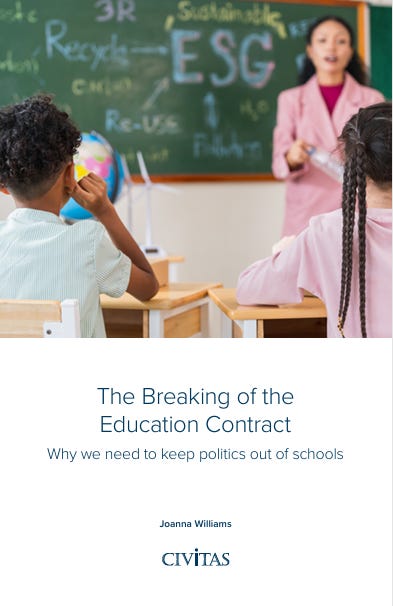
I’m delighted to announce that my new book, The Breaking of the Education Contract: Why we need to keep politics out of schools, is now available. Civitas has published it, and you can learn more and buy a copy here.
In the coming days, I will contact my paid subscribers and arrange to send them a free signed copy. It is not too late to join! A paid subscription also gets you full access to everything I write!
As a taster, here is the book’s introduction:
Forget toddlers. Every busy mum I know has had at least one tantrum. Often, it is when the pressures of being a good parent at home and a hard-working colleague in the office combine with some seemingly random but urgent request from their child’s school. The journalist Allison Pearson nailed the experience in her 2003 novel I Don’t Know How She Does It. Protagonist Kate Reddy finds herself in the kitchen late one night, ‘distressing’ shop-bought mince pies so they can be passed off as home-made in the school cake sale.
My own meltdown began with me scrabbling around for leftover sachets of sugar in my university department’s staff canteen. Later, exhausted at the end of a long day, I sat at home cutting up the sachets, pouring the sugar into the bin and handing over the ‘Fairtrade’ symbols for my 6-year-old son to glue onto a cardboard headband. To celebrate Fairtrade Week, his class were expected to come to school with a ‘Fairtrade hat’ they could wear in a playground parade.
All at once, the ridiculousness of the situation hit me. My son had next to no idea what Fairtrade meant. Poor farmers would be much better served by fertiliser and tractors, I thought, rather than having to doff their caps to Western middle-class consumers. And yet there I was, helping my son make a hat for a political cause I disagreed with, when I had dinner to cook and he had television to watch. Why?
This book is my attempt to explain how and why education has become so entwined with politics.
I draw upon my experiences as a secondary school teacher, university lecturer, educational researcher and mother to argue that, over the course of many decades, education has stopped being primarily concerned with the transmission of knowledge and culture and, instead, has become focused on shaping children’s political outlook and moral values.
As a former teacher, I know this is a bold claim. So, let me be clear from the outset: I do not think my one-time colleagues spend their free time researching how to brainwash children and conspiring world domination. Rather, as I argue in this book, the cumulative impact of a century’s worth of educational reform has fundamentally altered the purpose of schools and universities, moving them in a more political direction, regardless of the intentions of individual teachers or lecturers.
Often, this involves encouraging children to reject the attitudes and values of their family members and instilling in them school-approved views on everything from sex and relationships to Britain’s allegedly racist past and which brand of bananas to buy in the supermarket (answer: Fairtrade).
In this way, without anyone specifically intending it, education stops being a ‘conversation between the generations’ and becomes a form of moral and social re-engineering, shaping children in line with new political values and assumptions. As a result, education and indoctrination become blurred.
This process of reshaping children’s attitudes and values begins long before they start formal schooling. Parenting campaigns focus upon ‘the first 1,000 days’, a period extending from pregnancy to a child’s second birthday. Although well-intentioned, the sheer volume of advice given to new mothers and fathers today sends the message that they cannot trust their own instincts and should neither rely on them nor on older family members.
Children are first introduced to new ‘expert-approved’ attitudes and values at nursery. Scotland has ‘Gender Friendly Nurseries’ where staff use ‘gender neutral language’ and initiate gender neutral activities. Toddlers might be greeted with the phrase ‘hello everyone’ instead of ‘hello girls and boys’, and referred to using ‘inclusive’ pronouns such as ‘they’ or ‘them’. They won’t find princess or superhero costumes in the dressing-up box, but unisex alternatives. This might seem harmless enough. But for the youngest children, learning that they are a boy who will grow up to be a man, or a girl who will grow up to be a woman, is an important part of their development.
Yet progressive educators encourage children to question these initial assumptions about their own identity. In 2016, Brighton Council’s school application form asked the parents of 4-year-olds to discuss with their offspring whether they wished to be a boy or a girl when they started school, or, if they were undecided about their gender, the question could be left unanswered. Once they start school, children will be engaged in projects that, intentionally or not, promote only one perspective on an issue, like my son’s Fairtrade hat-making.
Over 40 schools in Northern Ireland signed up to become ‘Schools of Sanctuary’, a scheme that offers support to refugees and migrants. One activity suggested by the organisation involved children writing anonymous Valentine’s Day messages to welcome ‘people seeking safety’. One school in Wales asked pupils to produce videos welcoming migrants and promoting the services of the Welsh Refugee Council. These initiatives are not ‘education’ as commonly understood. Educating children would involve teaching the history of migration, examining geographical trends and global conflicts, or discussing the push-and-pull factors for both migrants and host communities. Encouraging pupils to ‘welcome’ migrants requires them to take one side in a contentious debate. This is activism, not education.
Over the course of just a few weeks in 2025 came news that a 12-year-old girl was sent home from her secondary school in Rugby, and prevented from making a speech about ‘being British’, for wearing a Union Jack dress on ‘Culture Celebration Day’. Pupils had been asked to wear ‘traditional cultural dress’ reflecting their ‘nationality or family heritage’. This, it seems, did not include a celebration of British nationality or culture, although the school later apologised and invited her back. Meanwhile, Britain’s former education secretary Bridget Phillipson decreed that transgender teachers have a right to ask pupils to refer to them by the gender neutral title ‘Mx’, before clarifying that they can ‘request’ this title but not insist upon its use.
New relationships and sex education (RSE) guidance was issued, directing schools to teach secondary-age children about strangulation in a bid to tackle the harms of online pornography. And former Prime Minister Keir Starmer backed a campaign to have Adolescence, a Netflix drama about knife crime and the dangers of social media, shown in all schools.
Children learn to be welcoming of migrants, respectful of a person’s gender identity, ashamed to be British and wary of toxic masculinity. It is not important whether these are good causes or issues with which we, personally, agree or disagree. What matters is that schools are concerned with political issues and aim to cultivate particular attitudes and viewpoints in pupils. This may be due to government policies, the particular enthusiasms of activist teachers and school leaders or the demands of external organisations. The collective impact of all these expectations and initiatives is to transform education into a political project.
Through explicit instruction in comprehensive sexuality education (CSE), workshops grounded in critical race theory (CRT), the content of both the formal and ‘hidden’ curriculum and the work of individual activists in the classroom, education has morphed into indoctrination. This book explores how and why this has happened. We look at the impact of activist teachers, campaigning schools, ‘decolonised’ subjects and reading lists, and successive governments that have seen ‘put it on the curriculum’ as the solution to every conceivable social and economic problem. We examine how schools have come to replace education with a political project of morally re-engineering children to create citizens for an imagined future. This book makes the case for a return to education as an end in itself.
Get a copy of The Breaking of the Education Contract: Why we need to keep politics out of schools here.