
The Case Against the Equality Act
A review of Some More Equal Than Others by Alka Seghal Cuthbert and Anna Loutfi

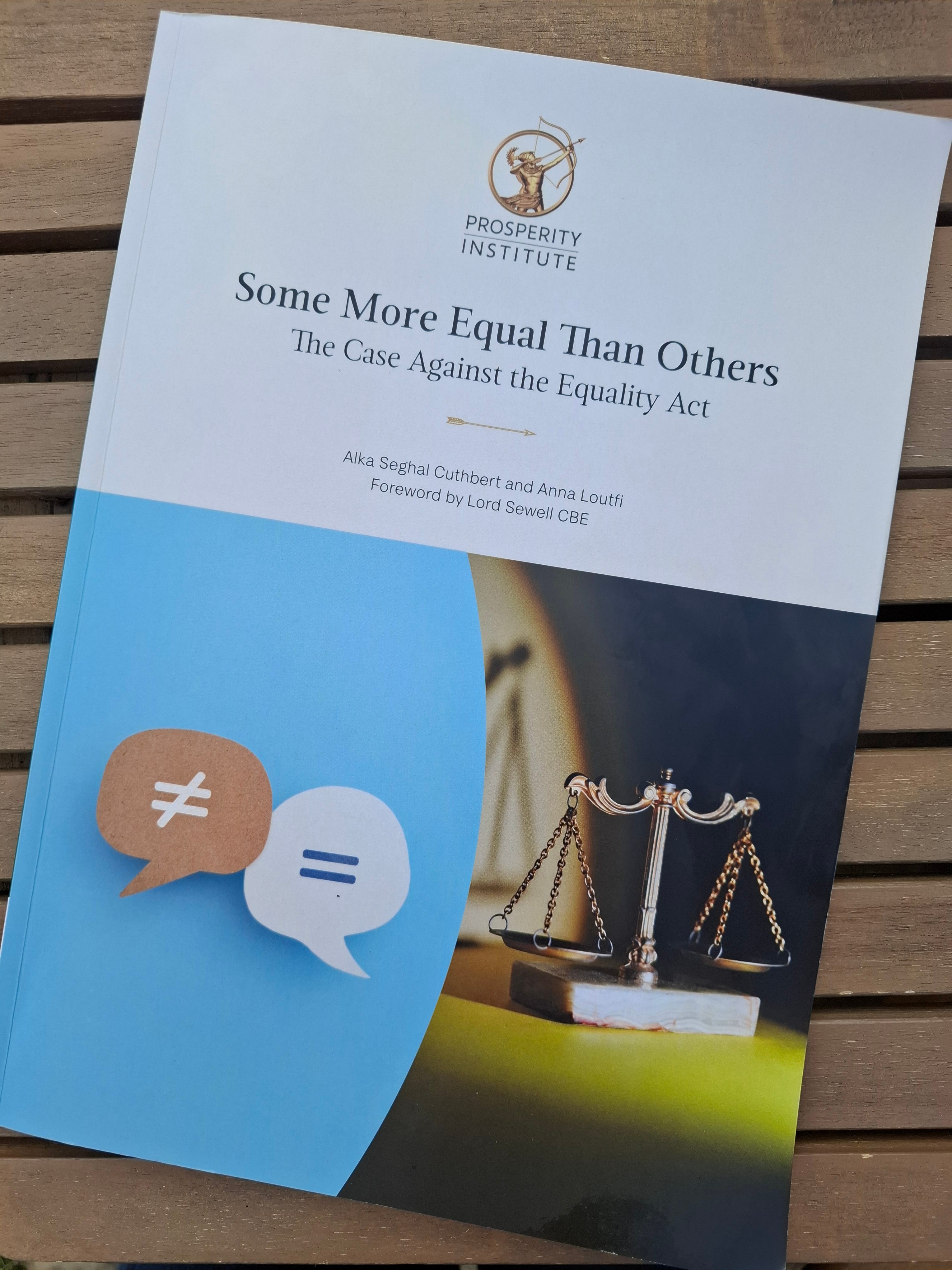
This week I attended the launch of a new paper from the Prosperity Institute: Some More Equal Than Others, The Case Against The Equality Act, by Alka Seghal Cuthbert and Anna Loutfi.
The authors do a tremendous job of explaining how the Equality Act has instigated legal and social changes that have far-reaching consequences for all aspects of life in Britain today. They show that far from simply bringing together disparate strands of existing anti-discrimination legislation (as is often suggested), the 2010 Act intentionally introduced entirely new ways of understanding equality, discrimination and the relationship between citizens and the state.
Seghal Cuthbert and Loutfi note that earlier anti-discrimination legislation was the creation of elected governments and, to a large extent, had the backing of a politically engaged public. The 2010 Act, on the other hand, 'was the product of an international group of lawyers imposing wide-ranging positive law upon the British public amidst dwindling voter turnout.’ Indeed, the Labour government that initiated the Equality Act was voted out of office before the new legislation became enshrined in law. The crucial point here is that a fundamental renegotiation of the social contract took place without the consent of the public.
Most significantly, the Equality Act represents a shift ‘from negative legal prohibitions against discrimination to a positive legal duty to enforce equality’. The impact of this change cannot be overstated. It moves the law away from penalising those guilty of actively discriminating against people, for example, by refusing to allow someone access to a service or a product or a job because of their sex or skin colour. Instead, the law becomes ‘the agent by which society will be reformed’ through a more substantive, transformative understanding of equality that requires a focus on compensating for presumed disadvantage and creating the conditions for equality of outcome. In other words, the Equality Act demands that institutions treat people differently and provide special dispensations to some to level the playing field for those assumed to be disadvantaged because of a particular ‘protected characteristic’.
There are serious problems with this approach. As Seghal Cuthbert and Loutfi point out, ‘the goal of ensuring equal opportunity is loose and diffuse compared to prohibiting acts of discrimination.’ ‘Discrimination’ itself takes on a new definition as ‘less favourable treatment’, a ‘catch-all’ and vague phrase that, all too often, seems to be determined by the subjective feelings of the person alleging discrimination, rather than by objective facts. This means that all kinds of social interactions, from not giving someone a promotion to not wishing them ‘happy birthday’, can become subject to legal proceedings and ‘there is little a party can do to reasonably anticipate what may or may not count later as discriminatory conduct’. In a culture that is both litigous and risk-averse, this has a crippling impact.
The Act identifies nine groups of people with ‘protected characteristics’, such as age, sex and race, but also, more controversially, gender reassignment and beliefs. Yet, as the authors note, ‘the number could be increased ad infinitum on the basis of perceived present or historical social disadvantage or unfavourable treatment.’ More pointedly, this emphasis on ‘protected characteristics’ means that the law no longer views people as individuals but as representatives of a group. It then becomes the business of the state to evaluate the status of particular groups and compensate for presumed disadvantages. The state, in other words, comes to play a far more interventionist role, managing all aspects of people’s lives and their interactions with one another.
This has considerable implications for our personal freedoms. Rather than liberty and equality being natural rights we can exercise through free speech and within a court of law, they become ‘goods to be conferred by the state upon individuals whose innate powers are limited or unrealisable due to social and economic inequalities.’
As Seghal Cuthbert and Loutfi conclude, the Equality Act ‘has left us less equal, less free, and with more justified discrimination than at any time in living memory.’ Their report is a brave call to abolish, or at very least substantively reform, the Equality Act.
Also this week, I read The Leopard by Giuseppe Tomasi Di Lampedusa. I’ve been listening to The Book Club podcast, and this is one of the featured books. It magnificently evokes life in Sicily in the years immediately before and after the unification of Italy. Lampedusa tells the story of one era ending, an old order dying, and a new elite, with more modern habits and values, struggling to become established. His story plays out through romantic relationships and changing family bonds. It is a compelling read, a truly great novel, but one that left me uncomfortable. The writing is beautiful, and the imagery lingers even after the book is complete, but every sentence is used to conjure a stench of rot, decay, and death.
Thank you to my paid subscribers for making it possible for me to write this.